
Exact subtension
Scenes are rendered at a fixed 64 px per mil. A 1.8 m target at 420 m is exactly 4.29 mils tall on the reticle you see.
Ranging trainer
Each scene is a view through a scope at a known distance. Measure the target in mils against the reticle, set the virtual Round MilDot the way you would the real one, read the range under the index and submit. No numbers are shown on the disc — you read it yourself, exactly like in the field.
Holds from the profile
Field conditions as in the angle-and-wind round, but now you answer in holds from your ballistic profile: the line-of-sight range, the elevation to dial for the range to dial (angle!) and the wind hold with its direction. Then three shots with the rifle's dispersion show where your numbers put the group on the target.
On roundmildot.com the round draws 5 or 10 of 27 public scenes.
Moving targets · ambush
A soldier walks or runs across your field of view. First observe: range him with the disc, time how fast he crosses the reticle (mils per second) and work out the lead: mils per second × time of flight from the card of your profile (SS109 by default). Then the ambush: put the crosshair on his path, wait until he is exactly your lead in front of the crosshair and fire. The bullet flies the real time of flight; a wrong range sends it high or low by the card's elevation difference.
On roundmildot.com there are 7 moving targets; the training set has 19.
Field
Each scene comes with field conditions: the inclinometer angle to the target and the wind from a flag or mirage, with its direction to the line of fire. Give three answers from the disc: the line-of-sight range, the range to dial (read at the angle mark next to the index) and the effective crosswind from the WIND tables printed on the disc. Conditions are drawn anew every round.
On roundmildot.com the field round draws 5 or 10 of 27 public scenes, with new conditions each time.
Plate drill
One plate per rung of the ladder, from 1.2 mils down. The clock runs for the whole drill: read the plate, set the disc, type the range, press Enter and the next plate is already there. The disc stays where you left it, like the real one.
On roundmildot.com the drill has 5 rungs per plate; the full ladder is in the training set.
Exam
You get only the kind of target, not its size: take the standard size yourself, read the reticle, set the disc and call the range. No marks, no feedback and no score until the end. Pass: at least 80 % of calls within ±10 %.
Standard sizes to know
On roundmildot.com the exam draws 10 or 20 of 27 public scenes; the training set draws from 77.
Drag to aim · wheel or +/− to zoom (first focal plane: mils stay mils)
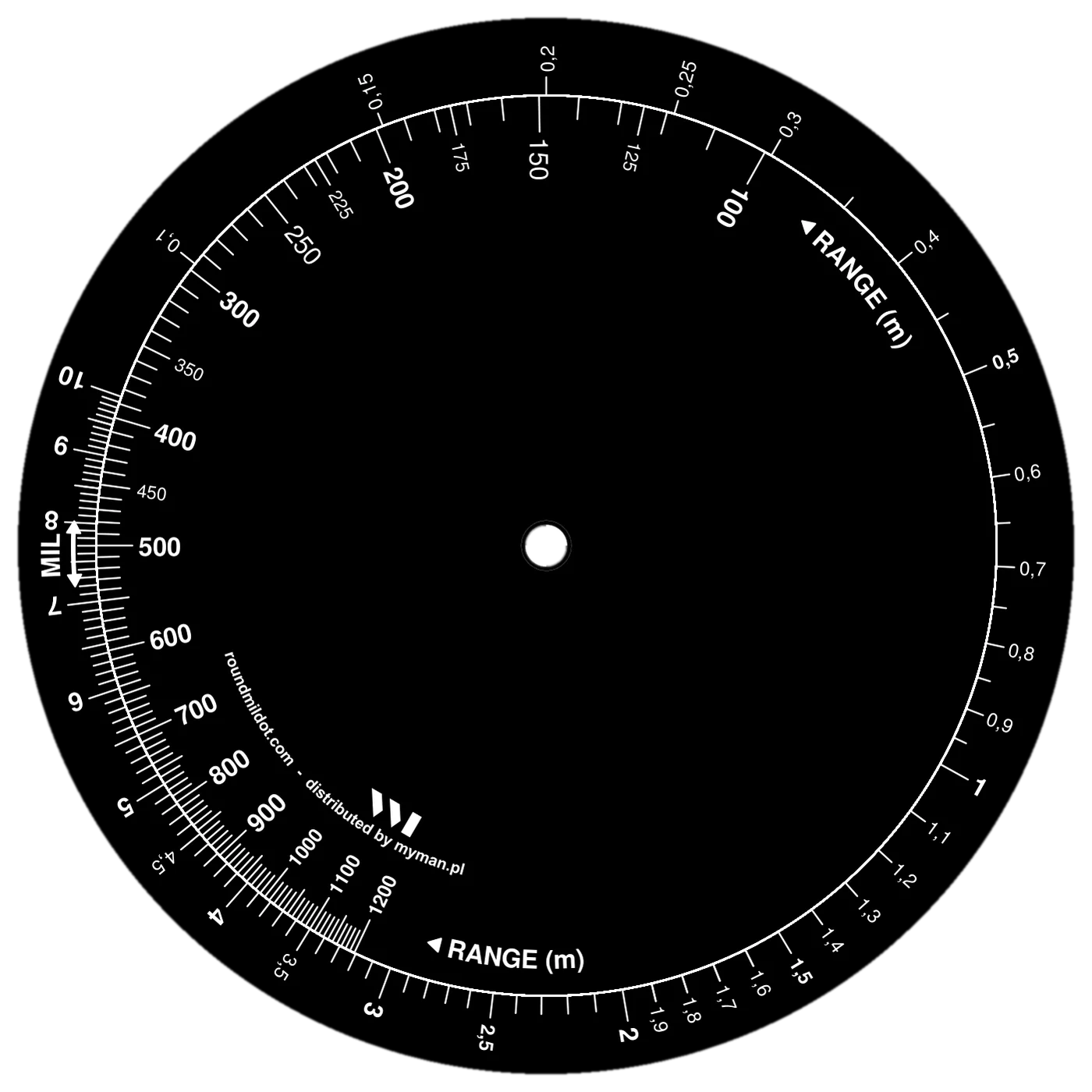
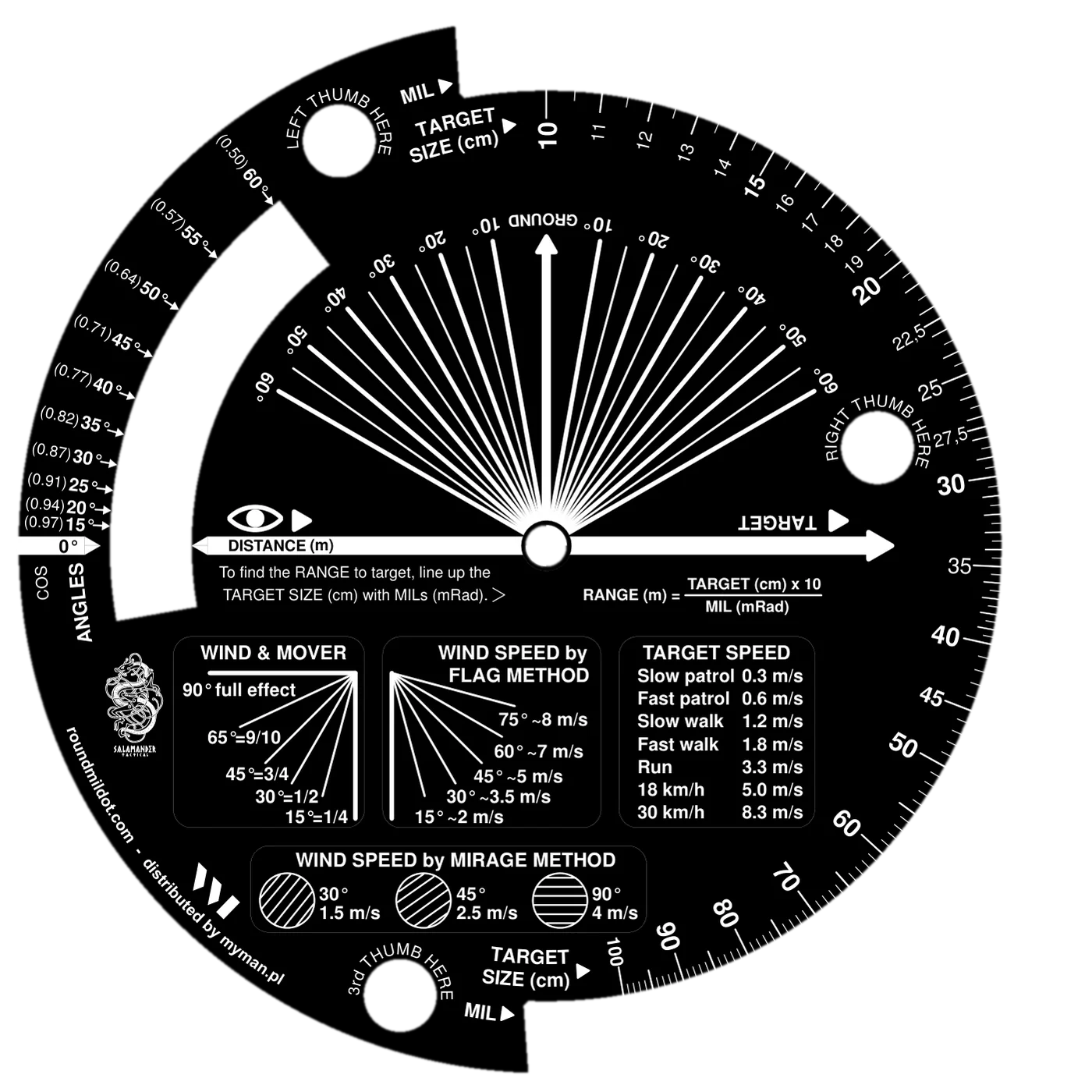
Drag the disc or use ← → (Shift = coarse). Target over 100 cm? Halve both: 90 cm against half the mils.
Conditions
Space starts and stops it while you observe.
Results
More reticles, targets and terrain for training groups — the complete set is available for courses and as a separate product.
Ask about the full setAbout the scenes
Scenes are rendered at a fixed 64 px per mil. A 1.8 m target at 420 m is exactly 4.29 mils tall on the reticle you see.
Mil-Dot, MIL hash and J&P JP2 Tac, from the same calibrated library as our holdover cards. Zoom never changes the reading.
The disc is built from the production files with the same scale constants as the physical Round MilDot: ≤0.23 % against cm × 10 / mils.