Cold and batteries
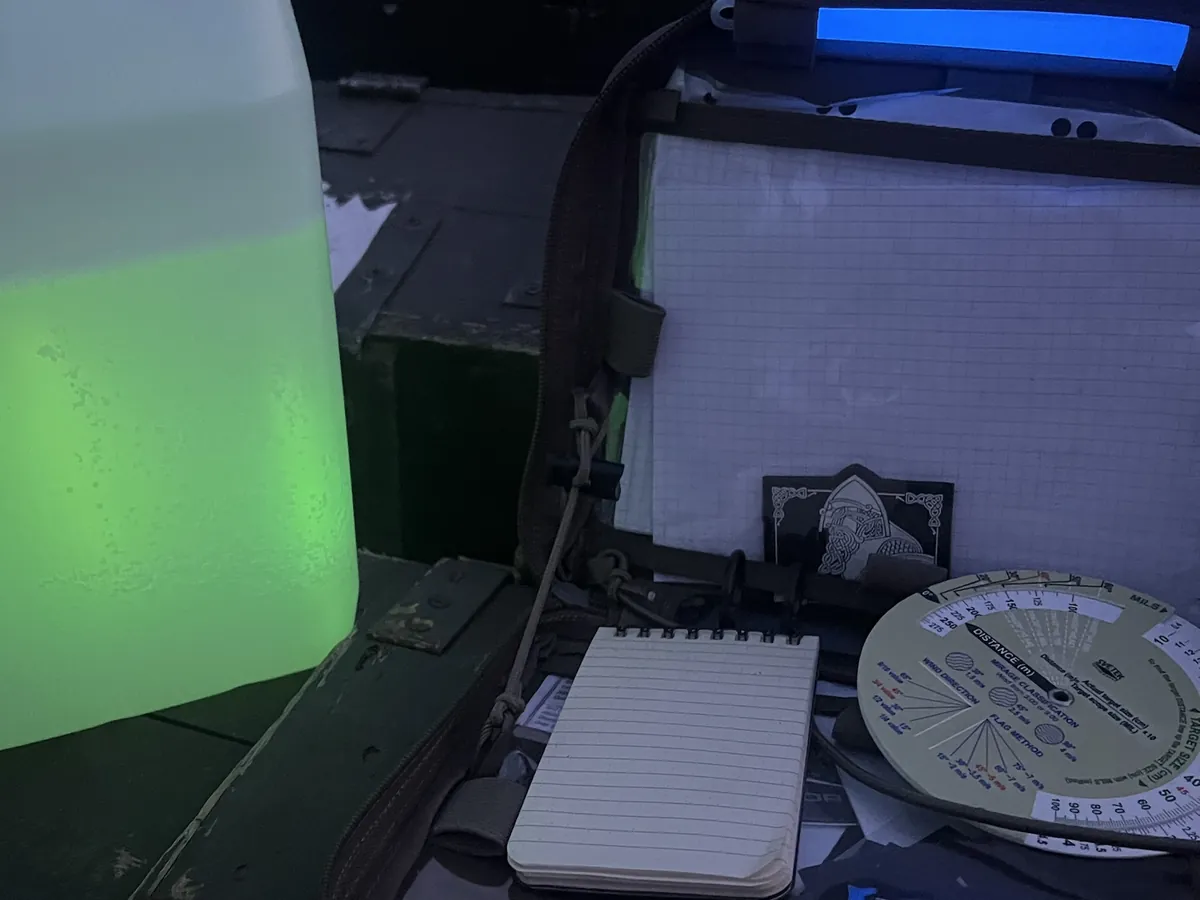
Electronics fail in frost and at the worst moment. The disc works at −30 °C and after a week at the bottom of a pack.
Analogue mil-ranging computer · metric
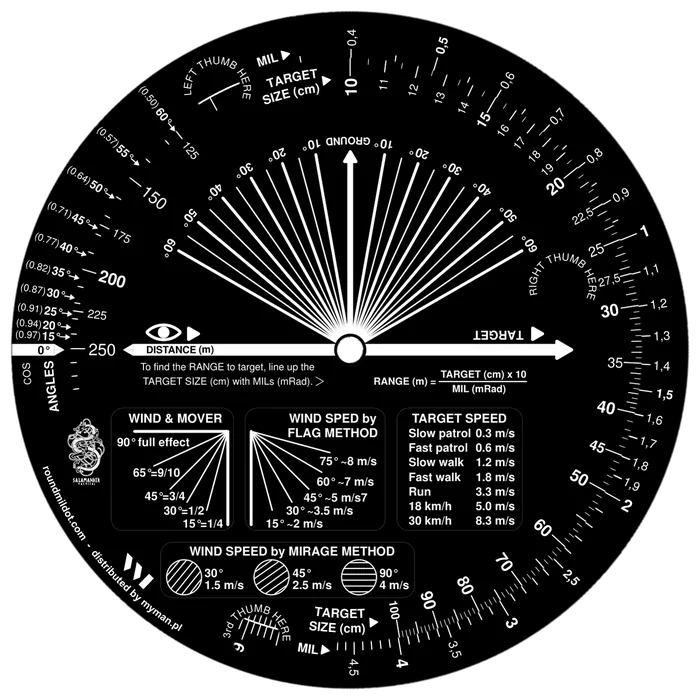
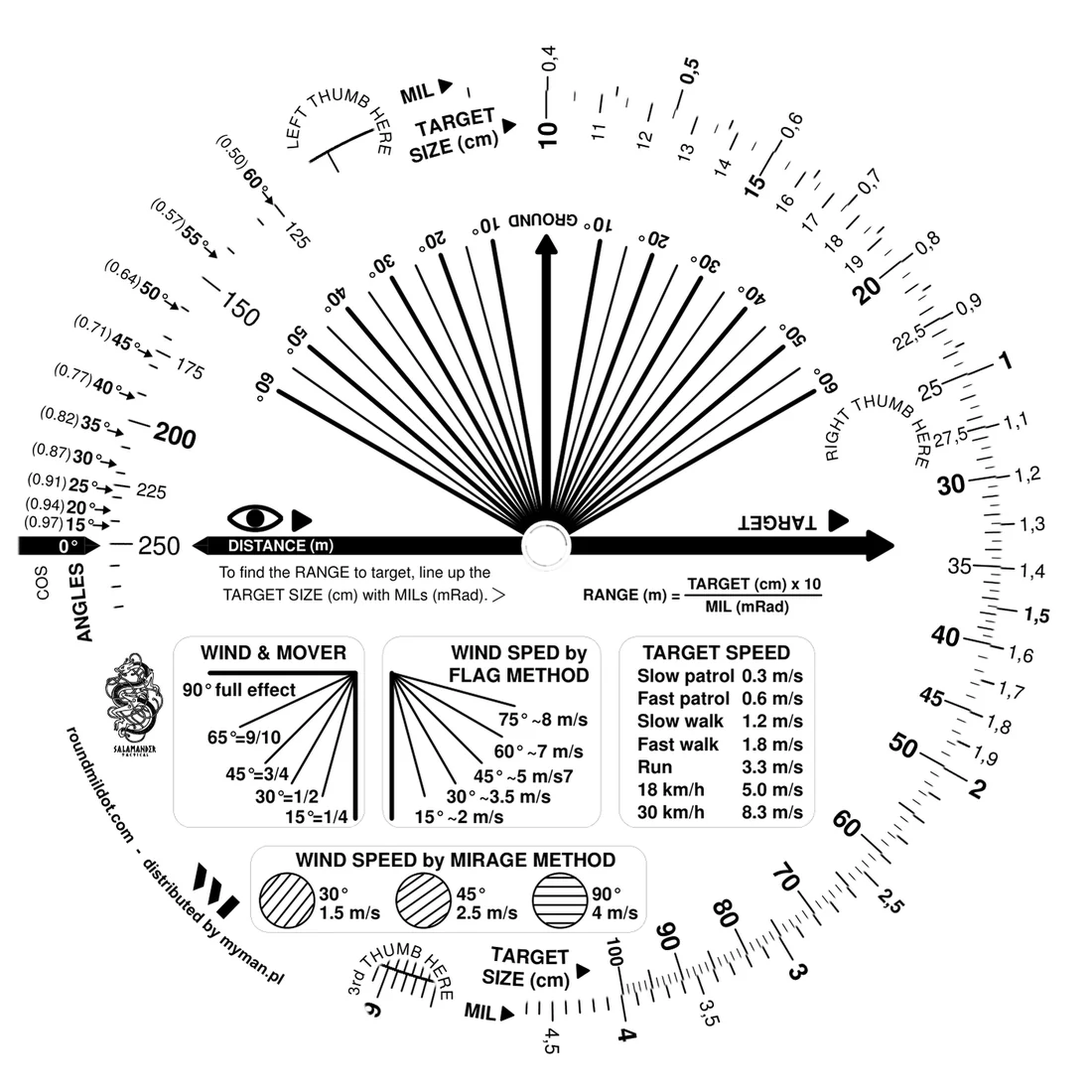
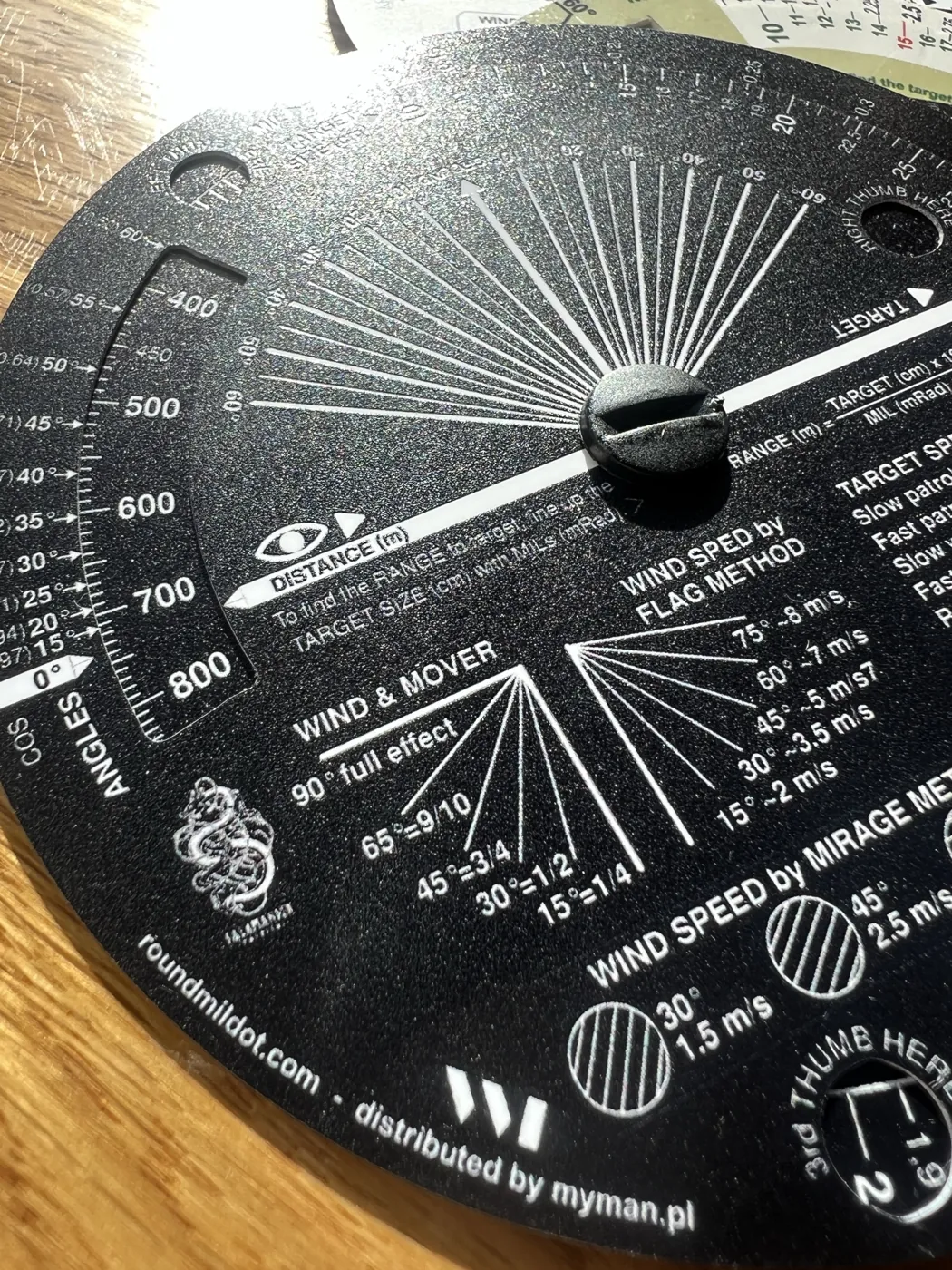
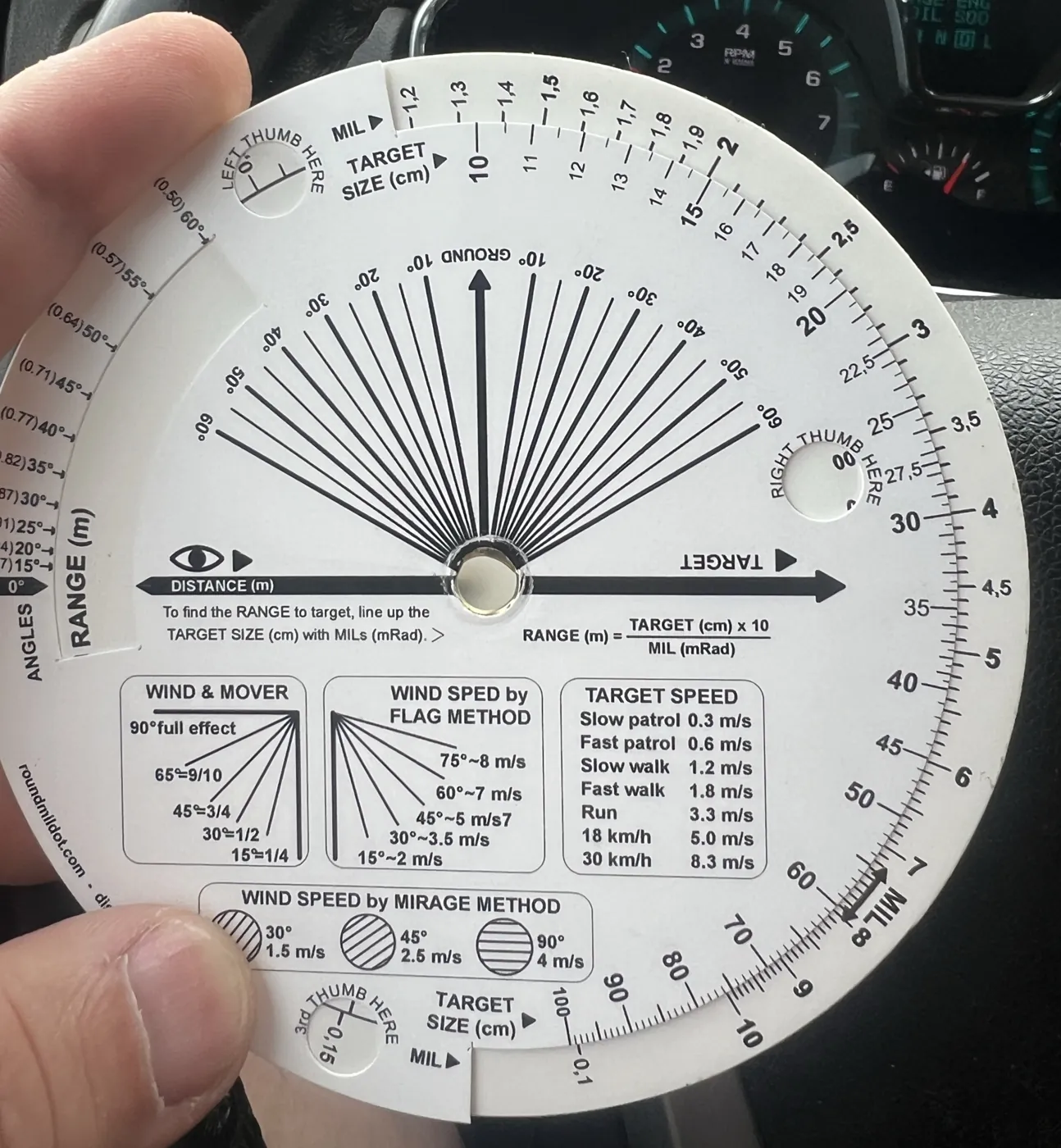
Two discs and a rivet. Set the target size in centimetres against your reading in mils and the window shows the range in metres: 100 to 1200 m, no batteries, no emission, no app. This is the real disc, rendered from its production files — turn it.
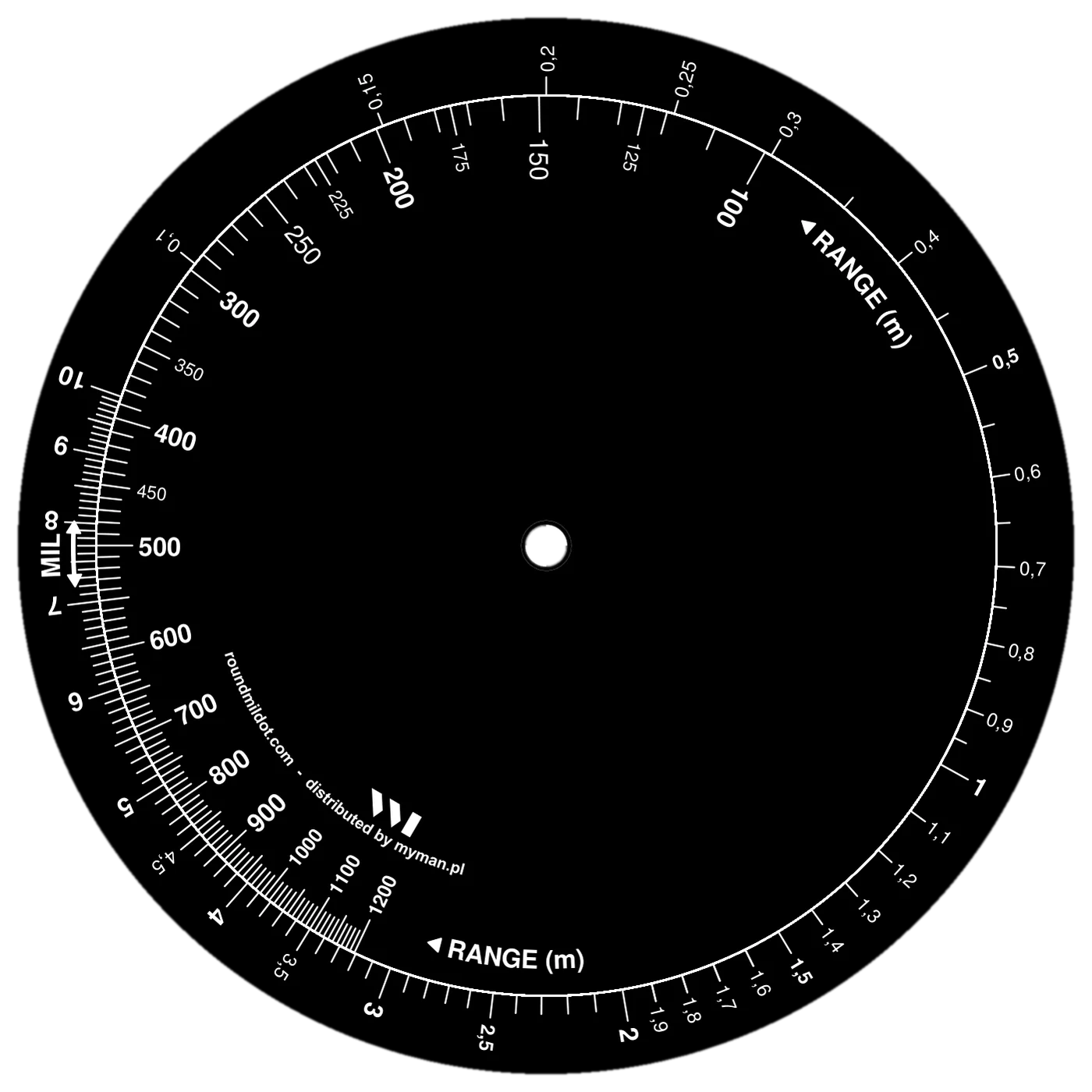
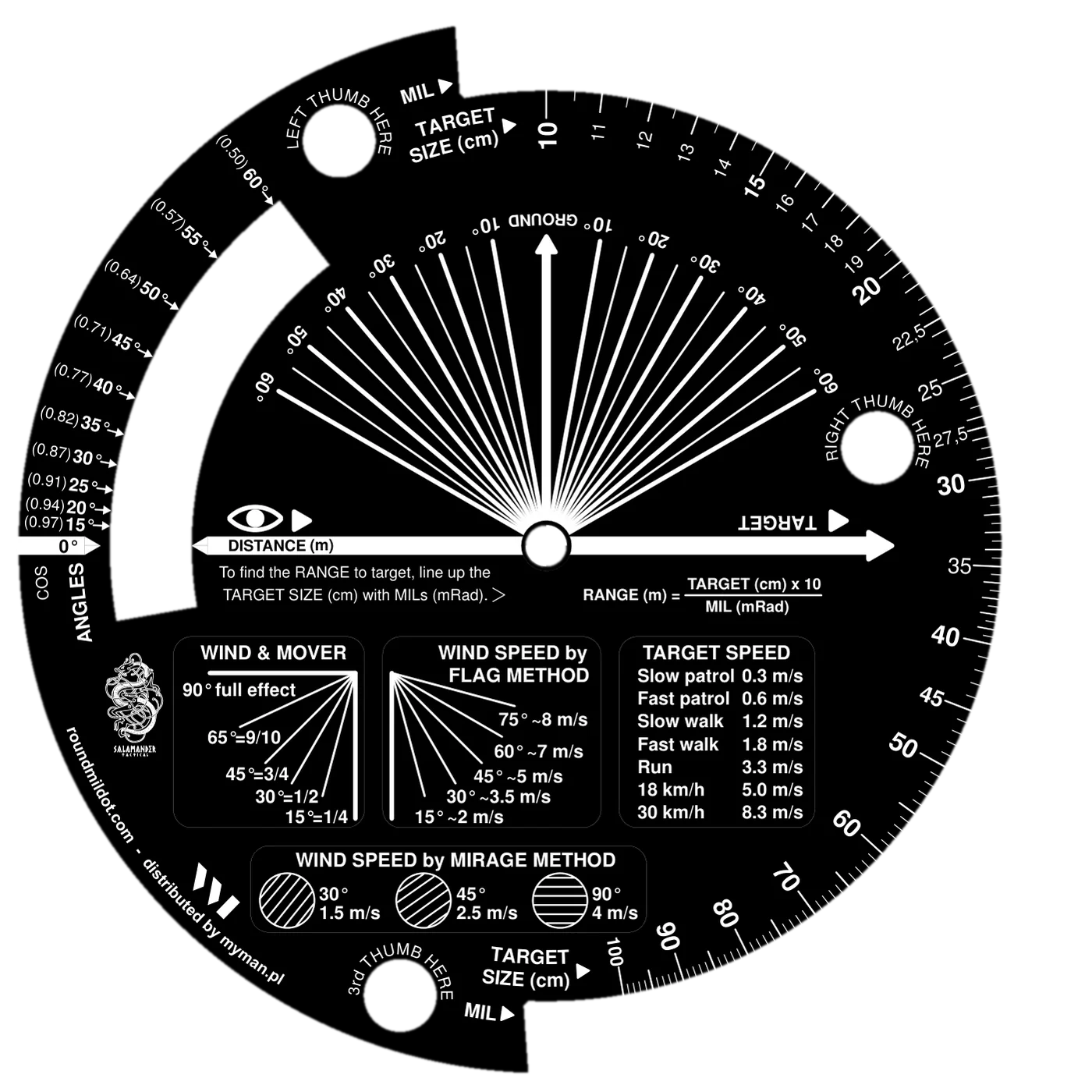
Drag the disc to turn it · ← → fine steps, Shift for 2°
Why an analogue computer
A laser rangefinder is the best tool you can have — until it isn't. Reticle ranging is what's left, and the disc takes the arithmetic out of it.
Electronics fail in frost and at the worst moment. The disc works at −30 °C and after a week at the bottom of a pack.
A laser needs a clean return. Thin targets, grass, rain, fog and angled surfaces often give none. The reticle still sees the target.
A laser beam is a signal. Reticle ranging is passive: you only look.
Many stages and training modules require ranging without electronics. One turn is the fastest legal method.
Centimetres × 10 ÷ mils is easy at a desk and error-prone behind the rifle. The disc removes the division and the decimal point.
Why analogue
Every electronic device is a battery, an emitter and a single point of failure. A serious ranging plan has layers, and the layers that still work when everything else is off are analogue.
| Layer | Ranging method | Fails when |
|---|---|---|
| First choice | Laser rangefinder | battery, cold, no return from small or wet targets, emission detected |
| Backup | Reticle + Round MilDot | you cannot see the target |
| Fallback | Reticle + printed mil-range table | slower; the table covers fixed sizes only |
| Last resort | Reticle + mental maths: cm × 10 ÷ mils | stress, fatigue, a slipped decimal point |
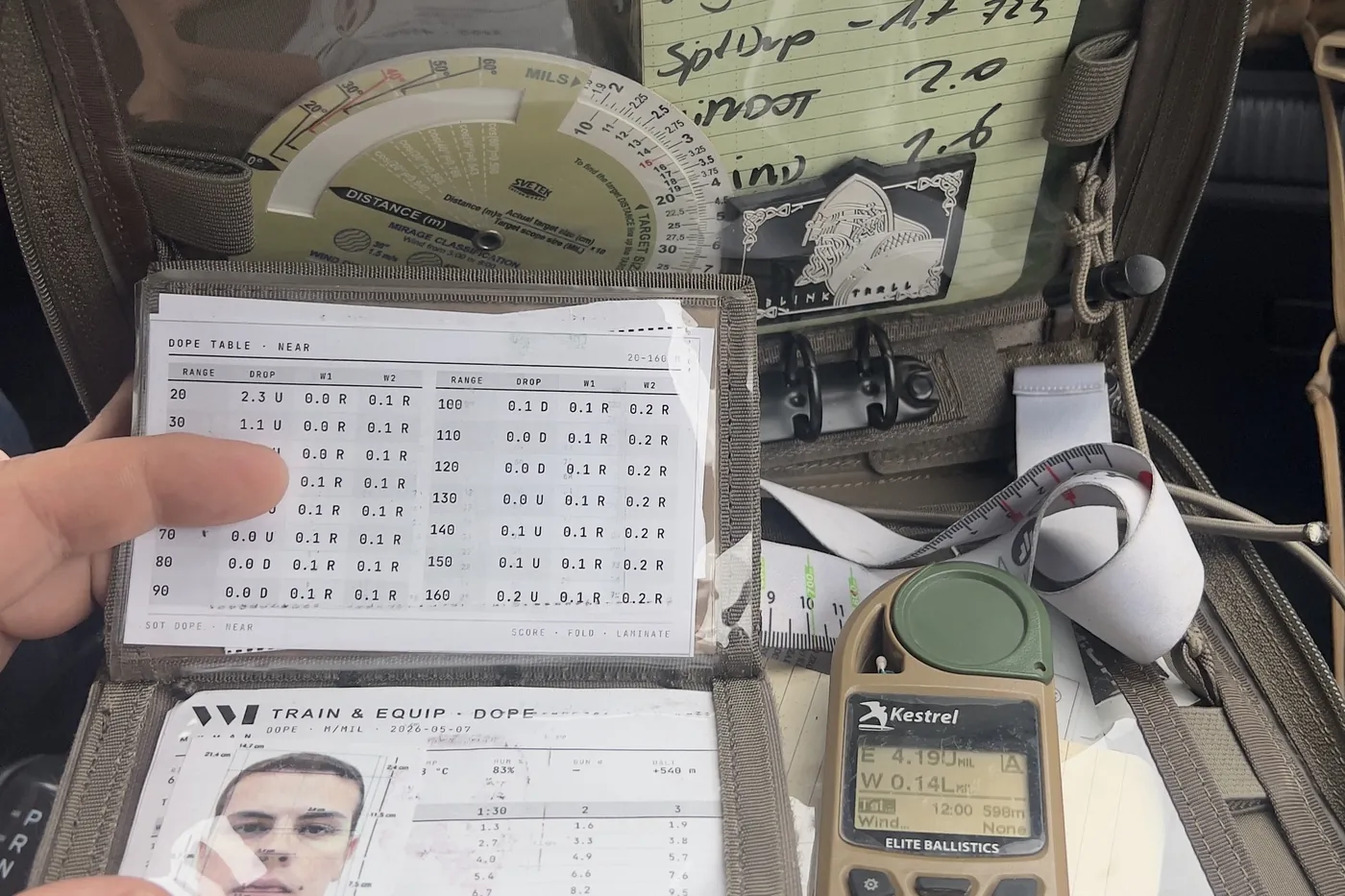
Satellite-navigation interference has been reported around the Baltic Sea since 2023. Anything that depends on GNSS or a radio link can be denied. A disc cannot.
Laser rangefinders and IR illuminators can be picked up by warning receivers and night-vision devices. Looking through a reticle emits nothing.
If the laser does all your ranging, the day it fails you range by guesswork. A few minutes a week with the disc keeps the relationship in your hands.
No charging, no batteries, no updates. A disc costs a fraction of a rangefinder and can go to every member of a team, a club or a civil-defence unit.
Drills
Steel plates 12 and 20 inches wide are the standard long-range targets. On the metric disc they are 30.5 and 50.8 cm. Learn the ladder: your partner calls a reading, you set the disc and call the range, then check it against the table.
| Reading | Range | |
|---|---|---|
| 1.2 | 254 m | |
| 1.1 | 277 m | |
| 1.0 | 305 m | |
| 0.9 | 339 m | |
| 0.8 | 381 m | |
| 0.7 | 435 m | |
| 0.6 | 508 m | |
| 0.5 | 610 m | |
| 0.4 | 762 m | |
| 0.3 | 1016 m |
| Reading | Range | |
|---|---|---|
| 1.2 | 423 m | |
| 1.1 | 462 m | |
| 1.0 | 508 m | |
| 0.9 | 564 m | |
| 0.8 | 635 m | |
| 0.7 | 726 m | |
| 0.6 | 847 m | |
| 0.5 | 1016 m | |
| 0.4 | 1270 m · off scale | |
| 0.3 | 1693 m · off scale |
Set on the disc: 30.5 cm is half-way between 30 and 31; 50.8 cm just above 50. Values above 1200 m are beyond the disc's range scale: for the 20″ plate at 0.4 and 0.3 mils use the formula. Tap ↑ to set any row on the simulator.
The principle
Round MilDot is a logarithmic slide rule bent into a circle. The formula is printed on the disc, so you can always check a result by hand.
Read how many mils the target spans in your reticle. First focal plane (FFP): at any magnification. Second focal plane (SFP): only at the magnification the reticle is calibrated for.
Turn the discs until the target size in centimetres on the upper disc sits against your reading on the lower disc's MIL ring.
The window shows the range in metres at the 0° index. The scale is logarithmic, so the reading is just as precise at 150 m as at 900 m.
Divide size and reading by the same number. A car 145 cm high reading 1.45 mils is the same as 72.5 cm at 0.725 mils: 1000 m. The ratio is what the disc computes.
Anatomy
The upper disc carries the target scale and the observer's tables. The lower disc carries the MIL ring and the range scale you read through the window.
Turn it over
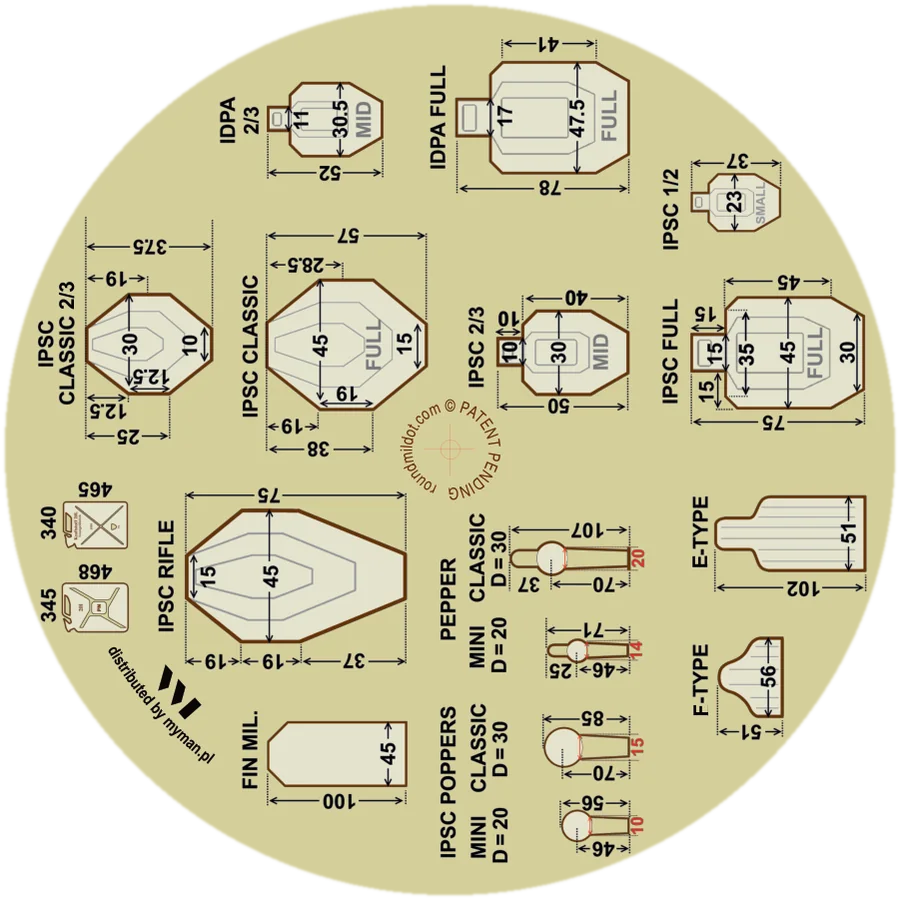
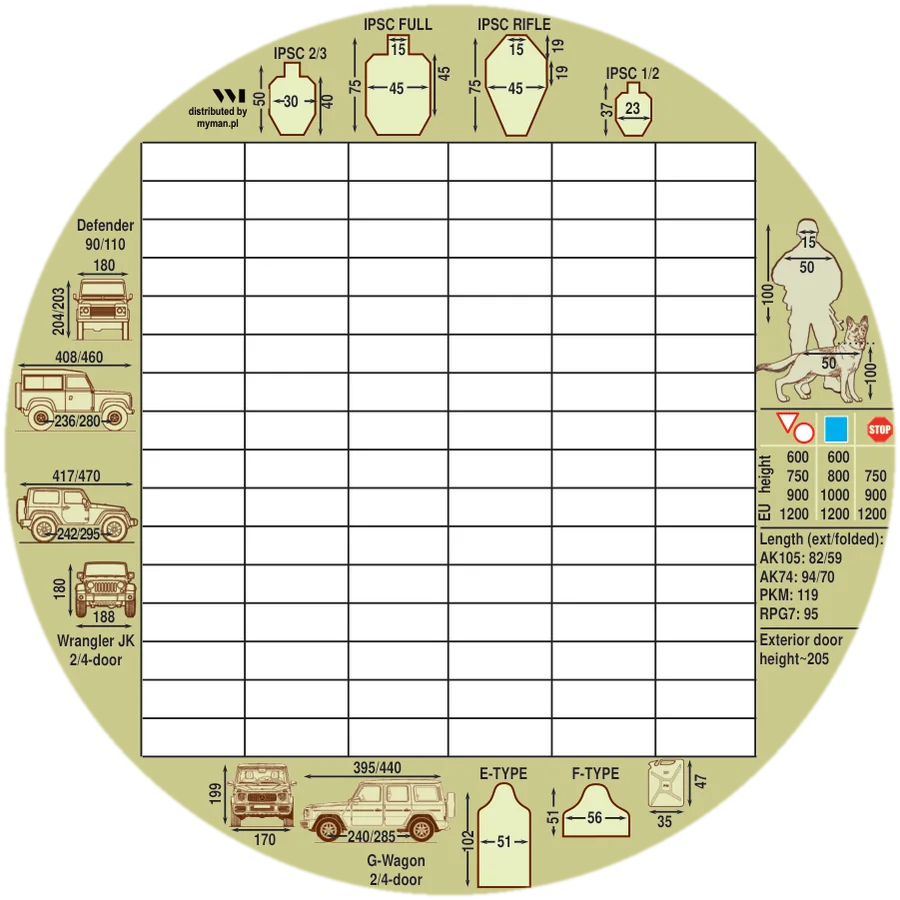
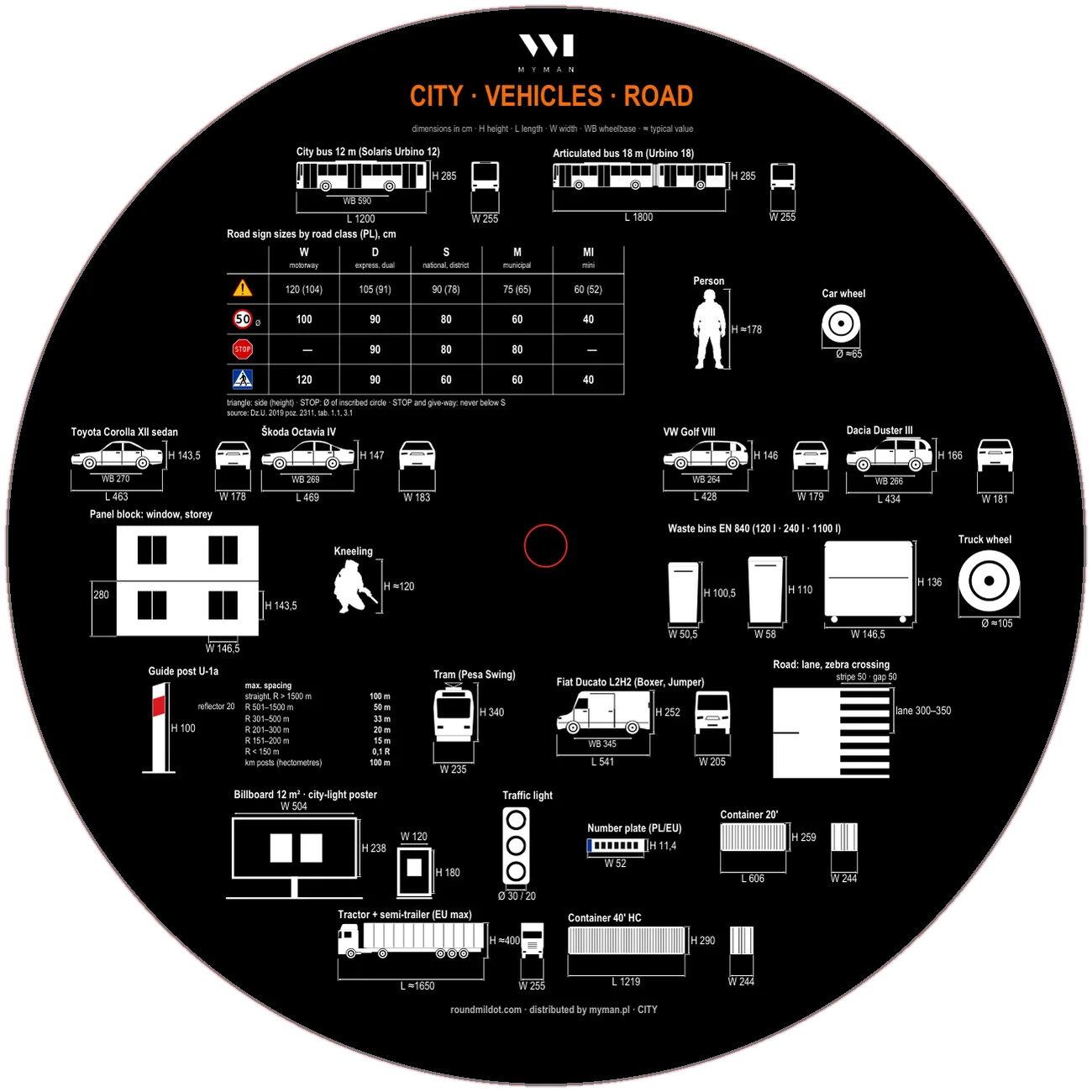
The back of the lower disc carries reference sizes to set on the front. Two versions exist; a third disc on the same rivet is in preparation.
Accuracy
We measured the production files directly: label positions against an ideal logarithmic scale, then simulated turning the discs for dozens of target/reading pairs.
Two assumptions: the target's real size and your reading. 10 % off on the size is 10 % off on the range. A 0.1 mil reading error matters more the smaller the reading — at 0.5 mils it is 20 %, at 3 mils only 3 %.
Ten cases across the whole scale, with the acceptance band for each. Every value computed with the formula, every expected reading simulated on the production files.
| Target | cm | mils | Range | Accept | |
|---|---|---|---|---|---|
| Torso, shoulders | 50 | 2 | 250 m | 246–254 | |
| IPSC target, width | 45 | 0.45 | 1000 m | 985–1015 | |
| Target 75 cm tall | 75 | 1.5 | 500 m | 492–507 | |
| 30 cm plate | 30 | 1 | 300 m | 296–304 | |
| Crouching person | 100 | 1 | 1000 m | 985–1015 | |
| Head with helmet | 20 | 1 | 200 m | 197–203 | |
| Target 60 cm | 60 | 4 | 150 m | 148–152 | |
| Door, half height | 90 | 0.75 | 1200 m | 1182–1218 | |
| 25 cm plate | 25 | 2.5 | 100 m | 98–101 | |
| Standing person, half | 87.5 | 1.25 | 700 m | 690–710 |
In the field
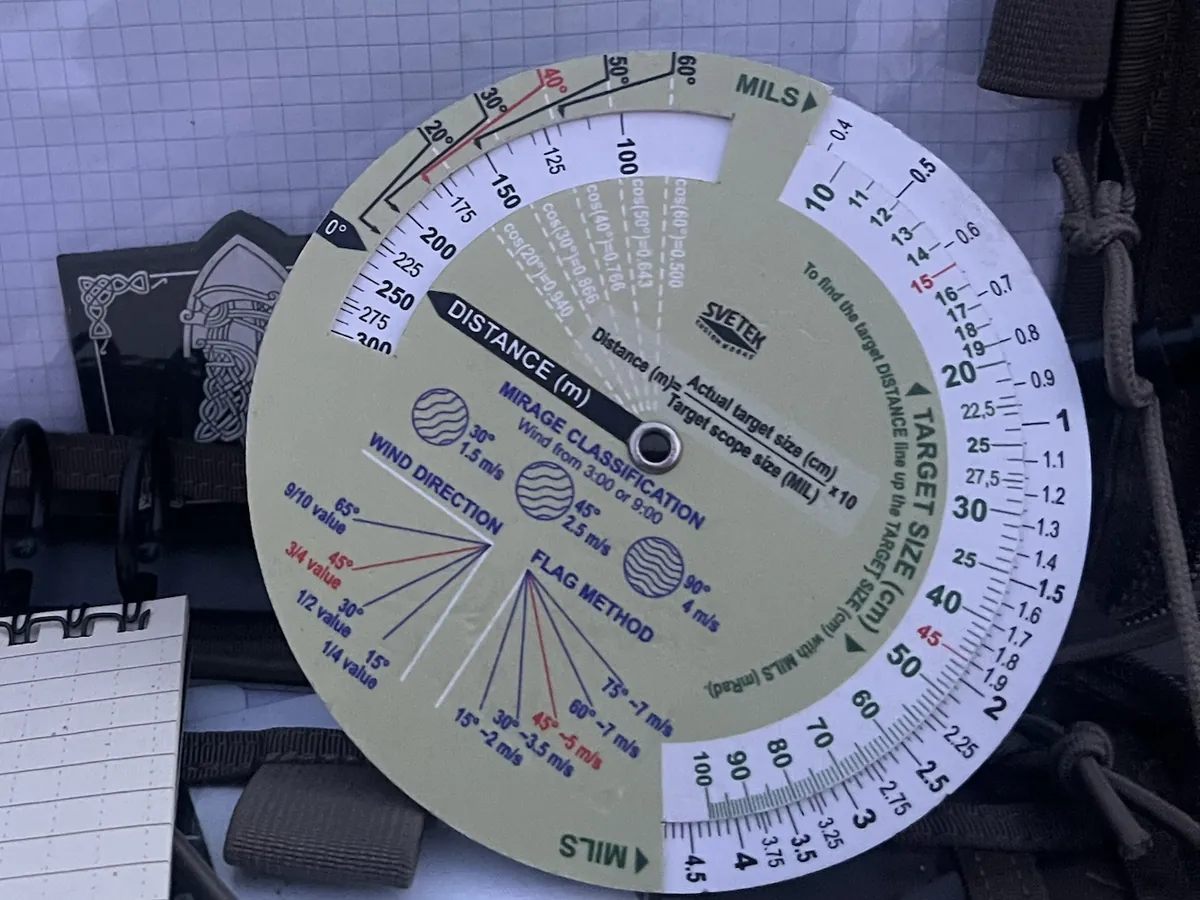
Real reference sizes, real readings. Every number below is the formula; set the same pair on the simulator above and read the window.
| Object | Dimension | cm |
|---|---|---|
| Person, adult (PL average) | height | ≈178 / 165 |
| Torso | shoulder width | ≈50 |
| IPSC target | width × height | 45 × 57 |
| Passenger car, compact | height | ≈145 |
| Compact SUV | height | ≈165 |
| Van (Ducato L2H2) | height | 252 |
| Semi-trailer | height · width | 400 · 255 |
| City bus | width · height | 255 · ≈330 |
| Window, panel block | width × height | 146.5 × 143.5 |
| Storey, panel block | floor to floor | 280 |
| Wheelie bin 240 L | height | 110 |
| Number plate (EU) | width | 52 |
| Traffic light lens | diameter | 20 / 30 |
| Road sign, round | diameter | 60 / 80 / 100 |
| Parking bay | width | 250 |
≈ typical value; other values from standards (EN 840, ISO 668, road regulations) and manufacturers' data sheets.
Compare
A laser is faster when it works. The disc is what works when it doesn't — and it teaches the relationship you need anyway.
| Round MilDot | Laser rangefinder | Rectangular slide rule | Mental maths / app | |
|---|---|---|---|---|
| Power | none | battery | none | none / phone battery |
| Emission | passive | active laser | passive | passive |
| Units | metric native: cm, mils, m | m / yd | mostly imperial | any |
| Small or wet targets | works if you can see it | may give no return | works | works |
| Operation | one hand, one turn | one button | two hands | head or screen |
| Wind, mover, slope tables | on the disc | slope only (some models) | slope, holdover | depends |
| Holdover | no — use your DOPE card | some models | yes | app only |
Specification
FAQ
The scales are in milliradians. Divide an MOA reading by 3.438 to get mils. It is still better to range in the same system as your reticle.
FFP reticles: any magnification. SFP reticles: only at the magnification the reticle is calibrated for, usually the highest. Otherwise the mil reading is wrong and the disc computes the wrong range precisely.
Range a part of it, or divide size and reading by the same number: 175 cm at 3.5 mils equals 87.5 cm at 1.75 mils — 500 m.
No. Elevation depends on your cartridge, barrel and atmosphere. Take the range from the disc to your own DOPE card or ballistic solver.
The 0° index gives the slant range. Read at the arrow for your slope angle and you get the horizontal range your ballistic table needs. Above about 30° and 600 m use the angle in your solver.
The scales themselves: reading error at most 0.23 % across the whole range, measured on the production files. In practice your error is the target size assumption and the reading.
This page shows the metric edition: centimetres, mils, metres, no mixed units. A US edition in inches and yards exists too — ask us.
There are no electronics. Clean it, dry it, use it.
Yes — write to us for bulk and training-set pricing.
We do. Round MilDot is designed and made by us (patent pending). In Poland you can also buy it from MyMan.
Get one
Shipped from Poland. White or black edition. Clubs, schools and units: ask for bulk pricing.